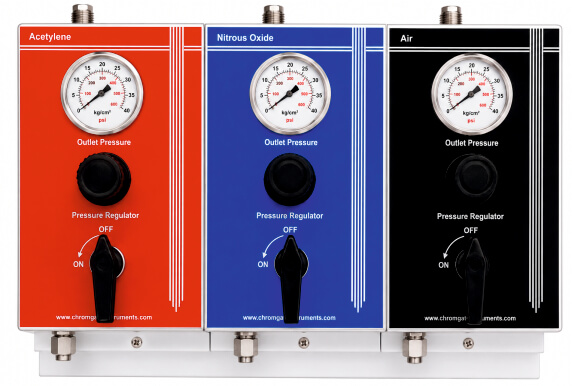
Explore Chromgate laboratory gas purification and control systems for GC, AAS, ICP and ICP-MS, with filtration, pressure regulation and monitoring.
Laboratory Gas Handling, Purification and Control System
Analytical instruments require gases to be delivered at an appropriate purity, pressure and flow. Variations in gas quality or pressure can affect instrument operation, analytical consistency and the service life of sensitive components.
The Chromgate Laboratory Gas Handling, Purification and Control System provides an organized solution for gas purification, pressure regulation, pressure monitoring and controlled gas delivery. It is designed for laboratories using instruments such as Gas Chromatographs, AAS, ICP-OES, ICP-MS, GC-MS and other analytical systems that require regulated laboratory gases.
Available in single-line and multi-line configurations, the system can be customized according to the gases, instruments, connection sizes, operating pressures and installation layout.
What Is a Laboratory Gas Purification System?
A laboratory gas purification system is installed between the gas source and the analytical instrument. Its purpose is to reduce specified contaminants from compatible gas streams while regulating and monitoring the downstream gas supply.
A complete gas handling and purification system may incorporate:
- Moisture traps
- Hydrocarbon traps
- Oxygen traps
- Inlet and outlet pressure gauges
- Adjustable pressure regulators
- On/Off or isolation valves
- Stainless-steel tubing
- Compatible compression fittings
- Colour-coded identification labels
- Wall-mounted protective enclosure
The number and type of purification stages should be selected separately for each gas and analytical application.
Why Is Gas Purification Important?
Even when high-purity cylinder gas is used, contaminants can enter the gas system through cylinders, regulators, tubing, fittings, installation work or atmospheric exposure during maintenance.
Depending on the application, unwanted moisture, oxygen, hydrocarbons and particulates may contribute to:
- Unstable instrument baselines
- Increased analytical noise
- Unwanted peaks or interferences
- Reduced detector sensitivity
- Contamination of gas lines
- Deterioration of sensitive columns or components
- Repeated maintenance requirements
- Inconsistent analytical performance
A properly selected purification system provides an additional stage of protection between the gas source and the instrument. However, it does not replace the need to use the gas grade recommended by the instrument manufacturer.
Purification Stages
Moisture Trap
A moisture trap is designed to reduce water vapour in a compatible gas stream. Moisture may enter the system through the gas source, tubing connections or atmospheric exposure.
Chromgate moisture traps can be supplied with suitable adsorbent media, such as Molecular Sieve 13X and indicator-type silica gel, according to the selected configuration.
Moisture control is particularly important in applications where a dry and stable gas supply is required.
Hydrocarbon Trap
A hydrocarbon trap helps reduce organic vapours and hydrocarbon contaminants from compatible gases. Activated-carbon-based media may be used according to the application.
Hydrocarbon control is important in analytical methods where trace organic compounds are measured because contamination can contribute to background noise, interference or unwanted peaks.
Oxygen Trap
An oxygen trap is designed to reduce residual oxygen from compatible gas streams. It may be required for carrier gases and other high-purity applications where oxygen can affect columns, detectors or analytical performance.
The oxygen-removal media must be selected according to the gas, flow, pressure and required purification capacity.
Not every gas line needs all three purification traps. The required combination should be determined from the instrument specification and application.
Pressure Regulation and Monitoring
Gas purification alone is not sufficient. The analytical instrument must also receive gas at the correct pressure.
Chromgate systems can incorporate:
- Inlet pressure indication
- Outlet pressure indication
- Adjustable pressure regulator
- Press-to-lock regulator knob
- Inlet and outlet isolation valves
- Individual control for each gas line
The pressure regulator allows the downstream supply to be adjusted according to the instrument requirement. A press-to-lock knob helps reduce accidental alteration after the desired pressure has been set.
Pressure gauges allow the operator to observe the gas pressure before and after regulation, depending on the selected system configuration.
The appropriate gauge range and regulator capacity must be selected according to the actual inlet pressure, outlet pressure and flow demand.
Available Gas-Line Configurations
Single Gas-Line System
A single-line system is suitable for one gas service or one dedicated instrument. It provides a compact arrangement where only one gas requires purification and pressure control.
Two Gas-Line System
A two-line system accommodates two independent gas streams within one enclosure. Each line can be provided with its own identification, purification stages, regulator, gauges and isolation valves.
Three- and Four-Line Systems
Three- and four-line configurations are suitable for laboratories or instruments requiring multiple gases. They provide a centralized and organized method of controlling several gas supplies.
Custom configurations may also be developed according to the number of gases, available installation space and project requirements.
Compatible Laboratory Gases
Subject to the selection of compatible wetted components, seals, regulators, valves and purification media, systems may be configured for gases such as:
- Nitrogen
- Hydrogen
- Helium
- Zero air
- Oxygen
- Argon
- Carbon dioxide
- Acetylene
- Nitrous oxide
- Ammonia
- Other compatible laboratory and industrial gases
The same component arrangement should not automatically be used for every gas. Gas compatibility must be verified before manufacturing and installation.
Special attention is required for flammable, oxidizing, corrosive, reactive and toxic gases.
Materials and Construction
A typical Chromgate system can be supplied with the following construction:
- Wall-mounted fabricated enclosure
- MS powder-coated body
- Polycarbonate colour-coded labels
- SS-316 internal tubing
- Compatible compression fittings
- Individual gas-line identification
- Accessible gauges, regulators and valves
- Removable or serviceable purification traps
- Neat internal tubing arrangement
The material of each wetted component should be selected according to the intended gas and operating conditions.
Applications
The system is suitable for gas purification and pressure control associated with:
- Gas Chromatography
- GC-MS
- Atomic Absorption Spectroscopy
- ICP-OES
- ICP-MS
- HR-ICP-MS
- TOC analysers
- Laboratory reactors
- Research instruments
- Quality-control instruments
- Other compatible analytical equipment
It can be installed in pharmaceutical, chemical, petrochemical, food, dairy, environmental, educational, research and industrial laboratories.
Information Required for System Selection
Before selecting a gas purification and control system, provide:
- Instrument make and model
- Analytical application
- Gas names
- Number of gas lines
- Recommended gas purity
- Available inlet pressure
- Required outlet pressure
- Required flow rate
- Connection sizes
- Distance from the cylinder to the instrument
- Existing manifold or regulator details
- Preferred mounting location
- Laboratory layout
- Applicable safety or project specifications
This information helps determine the appropriate regulators, gauges, traps, valves, tubing and connections.
Installation Considerations
The panel should be mounted at a convenient location where operators can clearly read the gauges and access the regulators, valves and purification traps.
The complete installation should consider:
- Safe cylinder storage
- Suitable cylinder regulators
- Manifold or changeover arrangement
- Correctly sized gas tubing
- Tube supports and casing-capping
- Accessible isolation points
- Proper gas identification
- Suitable ventilation
- Leak testing
- Instrument connection requirements
- Maintenance access
Gas installations should be completed and commissioned by trained personnel. All connections should be tested using a suitable leak-detection method before the instrument is operated.
Maintenance Requirements
Purification media have a limited service life. Their replacement frequency depends on gas quality, gas consumption, operating hours, system leakage and exposure during maintenance.
Routine maintenance should include:
- Inspection of pressure gauges
- Checking regulator operation
- Inspection of valves and tubing
- Leak testing of connections
- Monitoring for pressure instability
- Timely replacement of trap media
- Verification of gas labels
- Recording maintenance dates
The system must be isolated and safely depressurized before filters, tubing or components are serviced.
Benefits of a Chromgate Gas Purification System
A properly configured system provides:
- Organized gas purification and control
- Individual gas-line identification
- Adjustable downstream pressure
- Convenient pressure monitoring
- Local gas isolation
- Compact wall-mounted installation
- Reduced tubing and component clutter
- Convenient inspection and maintenance
- Single-line and multi-line options
- Customization for different instruments
Actual performance depends on the selected components, incoming gas quality, system design, installation and maintenance.
Frequently Asked Questions
Which purification traps are required for a gas chromatograph?
The required traps depend on the carrier gas, detector and analytical method. Moisture, oxygen and hydrocarbon traps are commonly considered, but the final selection should follow the instrument manufacturer’s recommendations.
Can one panel control multiple gases?
Yes. Multi-line panels can accommodate separate gases within one enclosure. Each gas line remains independently identified and controlled.
Is SS-316 tubing available?
Yes. SS-316 internal tubing can be provided, subject to the selected model and gas compatibility.
Can the pressure range be customized?
The regulator and pressure-gauge ranges can be selected according to the available inlet pressure and the instrument’s required outlet pressure.
How frequently should purification media be replaced?
Replacement frequency depends on gas quality, usage, contamination level and trap capacity. A preventive-maintenance schedule should be developed for each installation.
Can the system be used with ICP-MS?
Yes. A system can be configured for compatible ICP-MS gas requirements after reviewing the instrument specifications, gas consumption, pressure and connection details.
Related Gas Handling Products
A complete installation may also require:
- Cylinder pressure regulators
- Gas manifold systems
- High-pressure pigtails
- Automatic gas changeover systems
- Gas control boxes
- On/Off valve boxes
- Inline particulate filters
- Flashback arrestors
- SS-316 tubing and fittings
- Cylinder holding brackets
- Cylinder trolleys
- Gas cylinder cages
Request a Technical and Commercial Quotation
For product images, available configurations and technical information, visit:
Gas Handling, Purification & Control Systems – Chromgate Instruments
Contact Chromgate Instruments Private Limited to discuss your analytical instrument, gas requirements, pressure ranges, number of gas lines and installation layout.
Please share the instrument make and model, gas names, inlet and outlet pressures, flow requirements, connection sizes and project location so that our team can prepare an appropriate technical and commercial quotation.