
The purity, pressure and consistency of gases supplied to analytical instruments can directly influence instrument performance and the reliability of analytical results. Gas chromatography, atomic absorption spectroscopy, ICP-OES, ICP-MS and other analytical techniques require a clean and stable gas supply appropriate to the instrument and application.
A properly selected laboratory gas purification system helps remove unwanted moisture, oxygen, hydrocarbons and particulate contaminants from the gas stream. It can also provide pressure regulation, pressure monitoring, isolation and controlled delivery of gases to the connected instruments.
This guide explains the principal factors to consider when selecting a gas handling, purification and control system for a modern analytical laboratory.
Why Is Gas Purification Important in Analytical Laboratories?
Even high-purity cylinder gas may acquire contaminants from cylinders, regulators, tubing, fittings, connections or atmospheric exposure during installation and maintenance.
Depending on the analytical technique and gas service, contaminants may contribute to:
- Unstable instrument baselines
- Increased detector noise
- Unwanted peaks or analytical interference
- Reduced sensitivity
- Contamination of gas lines and instrument components
- Premature deterioration of columns or detectors
- Repeated maintenance and operational interruptions
- Inconsistent analytical performance
A laboratory gas purification system provides an additional purification stage between the gas source and the analytical instrument. The system should be selected according to the gas, instrument, required purity, flow rate, operating pressure and contaminants that need to be controlled.
What Is a Laboratory Gas Purification System?
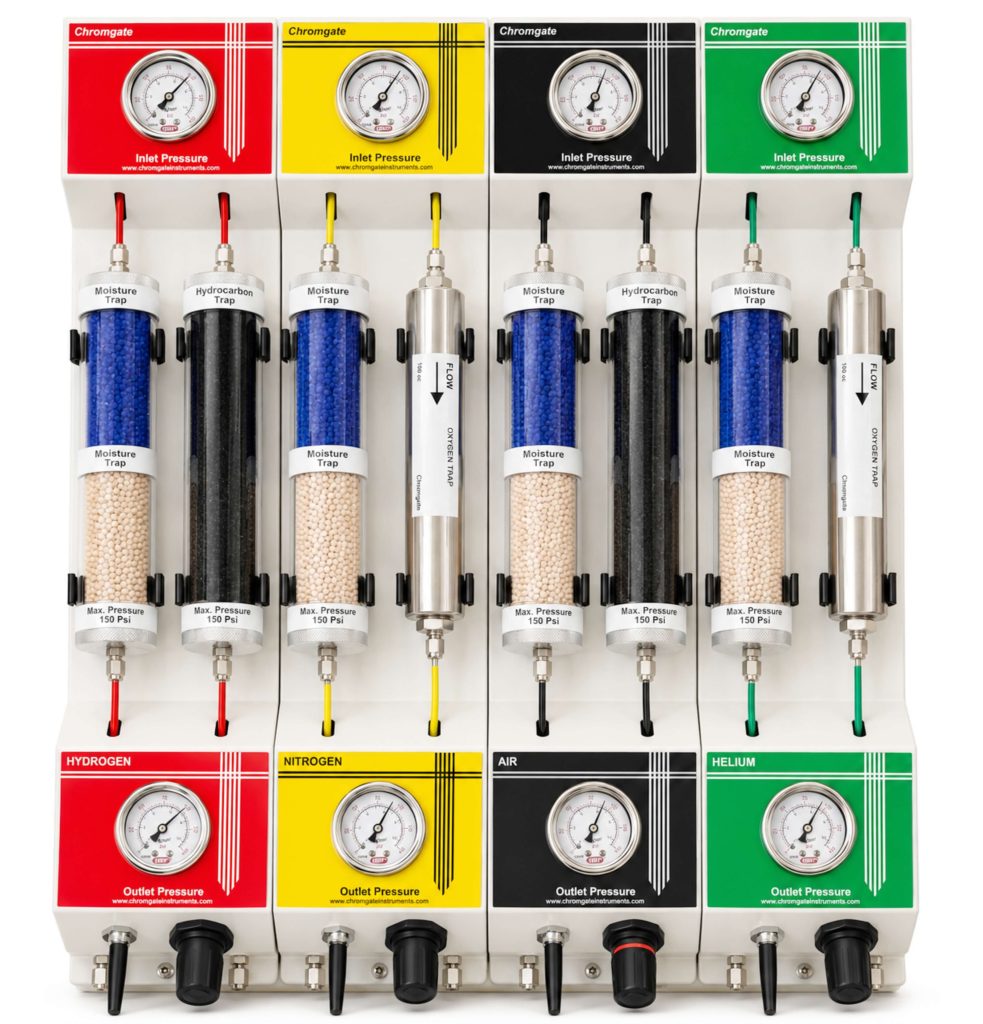
A laboratory gas purification system is an assembly designed to purify, monitor, regulate and control gases before they reach an analytical instrument or laboratory point of use.
A typical system may include:
- Moisture trap
- Hydrocarbon trap
- Oxygen trap
- Inlet and outlet pressure gauges
- Adjustable pressure regulator
- Isolation or On/Off valves
- Stainless-steel internal tubing
- Suitable compression fittings
- Colour-coded gas identification
- Wall-mounted protective enclosure
The exact configuration depends on the intended gas service, analytical application and customer requirements.
Chromgate Gas Handling, Purification & Control Systems are available in single-line and multi-line arrangements for laboratory and analytical gas applications.
Understand the Instrument’s Gas Requirements
The first step is to identify the gases required by the analytical instrument. Different instruments use gases for different purposes, including carrier gas, fuel gas, oxidant gas, plasma gas, purge gas, auxiliary gas and detector gas.
Gas Chromatography
A gas chromatograph may require:
- Helium
- Nitrogen
- Hydrogen
- Zero air
- Argon or argon-based mixtures, depending on the detector
Carrier-gas purity is especially important because contaminants can affect the analytical column, detector response and baseline stability.
Atomic Absorption Spectroscopy
An AAS installation may use gases such as:
- Acetylene
- Nitrous oxide
- Air
- Argon, depending on the instrument and application
Gas-system components must be selected according to the relevant gas characteristics, pressure requirements and safety considerations.
ICP-OES and ICP-MS
ICP systems commonly use argon for plasma, auxiliary and nebulizer functions. The gas-delivery arrangement must provide an appropriate supply pressure, flow capacity and cleanliness according to the instrument manufacturer’s requirements.
Other gases may also be required for specialized analytical configurations.
Always consult the instrument manufacturer’s gas-quality, pressure and flow specifications before finalizing the gas purification and distribution system.
Select the Appropriate Purification Traps
The required traps should be selected according to the contaminants that may affect the application.
1. Moisture Trap
A moisture trap is designed to reduce water vapour present in the gas stream. Moisture may enter through the gas source, regulator, tubing connections or atmospheric exposure.
Chromgate moisture traps can be configured with suitable adsorbent media, such as molecular sieve, according to the required application.
A moisture trap is particularly useful where dry gas is necessary for stable and reliable instrument operation.
2. Hydrocarbon Trap
A hydrocarbon trap helps reduce organic and hydrocarbon contaminants from the gas stream. Activated-carbon-based media may be used, depending on the purification requirement.
Hydrocarbon contamination is particularly undesirable in analytical applications where trace organic compounds are being measured.
3. Oxygen Trap
An oxygen trap helps remove residual oxygen from compatible gas streams. It is commonly considered for carrier-gas and other high-purity applications where oxygen may adversely affect instrument components, columns or analytical performance.
The oxygen-removal media must be compatible with the intended gas, flow, pressure and operating conditions.
Not every gas line requires all three traps. The purification arrangement should be selected separately for each gas according to the analytical application.
Choose the Correct Number of Gas Lines
Laboratory gas purification systems can be supplied in several configurations.
Single Gas-Line System
A single-line system is suitable when only one gas requires purification and pressure control. It offers a compact and economical arrangement for a dedicated instrument or gas service.
Two Gas-Line System
A two-line system can manage two separate gases within one enclosure. Each gas line should remain independently identified and controlled.
Three- or Four-Line System
Multi-line systems are suitable for instruments or laboratories requiring several gases. They provide an organized, centralized and professional gas-control arrangement.
Each gas line can be configured with appropriate purification traps, gauges, regulators and isolation valves according to the application.
The number of gas lines should be selected based on:
- Current instrument requirements
- Proposed future expansion
- Available installation space
- Gas-cylinder or manifold arrangement
- Required point-of-use connections
- Maintenance accessibility
Verify Pressure and Flow Requirements
Gas pressure is a critical selection parameter. Before ordering a purification system, determine:
- Available inlet pressure
- Required outlet pressure
- Maximum operating pressure
- Instrument gas-pressure requirement
- Required gas-flow rate
- Permissible pressure drop
- Distance between the gas source and instrument
A pressure regulator should provide stable and adjustable downstream pressure. Inlet and outlet pressure gauges allow the operator to monitor system conditions.
Chromgate systems can be provided with adjustable pressure regulators featuring a press-to-lock knob, helping the user set and secure the required outlet pressure.
The pressure range must be selected according to the actual application rather than using one common range for every gas and instrument.
Select Compatible Materials
All wetted components—including regulators, valves, traps, tubing, fittings and sealing materials—must be compatible with the selected gas.
Stainless-steel tubing is commonly used in high-purity laboratory gas installations because it provides:
- Good corrosion resistance
- Mechanical strength
- Clean internal gas passages
- Reliable compression-fitting connections
- Suitability for permanent gas-distribution installations
Chromgate systems can incorporate SS-316 internal tubing and compatible fittings, subject to the selected model and application.
Material selection is especially important when handling reactive, oxidizing, flammable, corrosive or high-purity gases. Compatibility should be verified before installation.
Look for Clear Gas Identification
Clear gas identification improves safety, operation and maintenance. Each gas line should be labelled according to the gas being supplied.
Colour-coded labels or sleeves can help users distinguish between:
- Nitrogen
- Hydrogen
- Helium
- Zero air
- Oxygen
- Argon
- Carbon dioxide
- Acetylene
- Nitrous oxide
- Other compatible laboratory gases
Gas identification should be consistent throughout the complete installation, including the cylinder area, regulator, manifold, tubing route, control panel and point of use.
Consider Installation and Accessibility
A wall-mounted enclosure provides a compact and organized arrangement while keeping gas-control components accessible for inspection and maintenance.
Before installation, consider:
- Distance from the gas source
- Location of the analytical instrument
- Accessibility of regulators and valves
- Visibility of pressure gauges
- Tubing route and protection
- Ventilation requirements
- Cylinder-storage arrangement
- Availability of isolation points
- Future maintenance access
- Compliance with applicable safety requirements
Gas tubing should be installed using suitable supports, clamps, channels or casing-capping systems. All connections should be checked using an appropriate leak-testing method before the gas supply is introduced to the instrument.
Installation and commissioning should be carried out by trained and authorized personnel.
Essential Features to Consider
A laboratory gas purification and control system should be evaluated for the following features:
- Appropriate purification stages
- Independent gas-line configuration
- Compatible wetted materials
- Suitable inlet and outlet connections
- Accurate pressure monitoring
- Stable pressure regulation
- Convenient isolation valves
- Clear gas identification
- Neat internal tubing arrangement
- Accessible filter-trap replacement
- Strong wall-mounted enclosure
- Easy inspection and maintenance
- Provision for customized gas-line configurations
Selection should be based on genuine technical requirements rather than appearance alone.
Maintenance of a Gas Purification System
Purification media have a finite service life. Replacement frequency depends on gas quality, flow rate, operating hours, system tightness and atmospheric exposure.
A preventive-maintenance programme should include:
- Regular inspection of pressure gauges
- Checking regulators and isolation valves
- Leak testing of connections
- Inspection of tubing and fittings
- Monitoring for pressure instability
- Timely replacement or regeneration of purification media
- Confirmation of gas-line identification
- Recording maintenance and trap-replacement dates
Purification traps should not be opened or replaced while the system is pressurized. The gas supply must be safely isolated and residual pressure relieved by trained personnel before maintenance begins.
Chromgate Gas Handling, Purification & Control Systems
Chromgate Instruments Private Limited offers laboratory gas handling, purification and control systems designed for analytical and laboratory applications.
Systems can be configured for gases such as:
- Nitrogen
- Hydrogen
- Helium
- Zero air
- Oxygen
- Argon
- Carbon dioxide
- Acetylene
- Nitrous oxide
- Other compatible gases
Depending on the requirement, a system may incorporate moisture, hydrocarbon and oxygen traps, pressure gauges, adjustable regulators, isolation valves, stainless-steel tubing and suitable fittings within a wall-mounted powder-coated enclosure.
Single-line and multi-line configurations can be developed according to the analytical instrument, gas service, available space and laboratory layout.
Chromgate also offers associated gas-handling components, including:
- Double-stage cylinder regulators
- Gas manifolds
- Flexible pigtail hoses
- Automatic gas changeover systems
- Gas control boxes
- On/Off valve boxes
- Gas-selection boxes
- Flashback arrestors
- Inline particulate filters
- SS-316 tubing and fittings
- Cylinder holding brackets
- Cylinder trolleys
- Tubing-support and casing-capping systems
Frequently Asked Questions
Which purification traps are required for a gas chromatograph?
The required traps depend on the carrier gas, detector, instrument configuration and analytical application. Moisture, hydrocarbon and oxygen traps are commonly considered, but the final combination should follow the instrument manufacturer’s specifications.
Can one purification panel be used for multiple gases?
Yes. A multi-line panel can accommodate separate gas lines within one enclosure. Each line should have independent identification and components selected for the respective gas.
Is SS-316 tubing suitable for laboratory gas distribution?
SS-316 tubing is widely used for high-purity laboratory gas distribution because of its corrosion resistance, strength and clean gas pathway. Its suitability must still be verified for the particular gas, pressure and environment.
How frequently should purification traps be replaced?
There is no single replacement interval for every installation. Service life depends on incoming gas quality, consumption, leakage, operating conditions and the capacity of the purification media.
Can the system be customized for GC, AAS or ICP instruments?
Yes. The number of gas lines, purification stages, connection sizes, pressure ranges, valves and tubing arrangement can be selected according to the instrument and site requirements.
Does the purification system replace high-purity cylinder gas?
No. The system should be used with gas of the grade recommended by the instrument manufacturer. It provides additional control and purification but cannot compensate for an unsuitable or heavily contaminated gas source.
Conclusion
Selecting the correct laboratory gas purification system requires a careful assessment of the analytical instrument, gas type, required purity, pressure, flow, contaminants, materials and installation conditions.
A properly configured system can support clean gas delivery, stable pressure control, organized operation and easier maintenance. It can also help protect sensitive analytical components and improve the reliability of laboratory operations.
For the best results, share the instrument model, required gases, inlet and outlet pressures, flow requirements, connection sizes and installation layout with the system supplier before finalizing the configuration.
Request a Technical Proposal
Chromgate Instruments Private Limited provides customized gas handling, purification and control systems for GC, AAS, ICP-OES, ICP-MS and other laboratory and analytical applications.
For product images, available configurations and technical specifications, visit:
Link: Gas Handling, Purification & Control Systems – Chromgate Instruments
Contact Chromgate to discuss your gas-line configuration, instrument requirements and installation layout and to request a technical and commercial quotation.